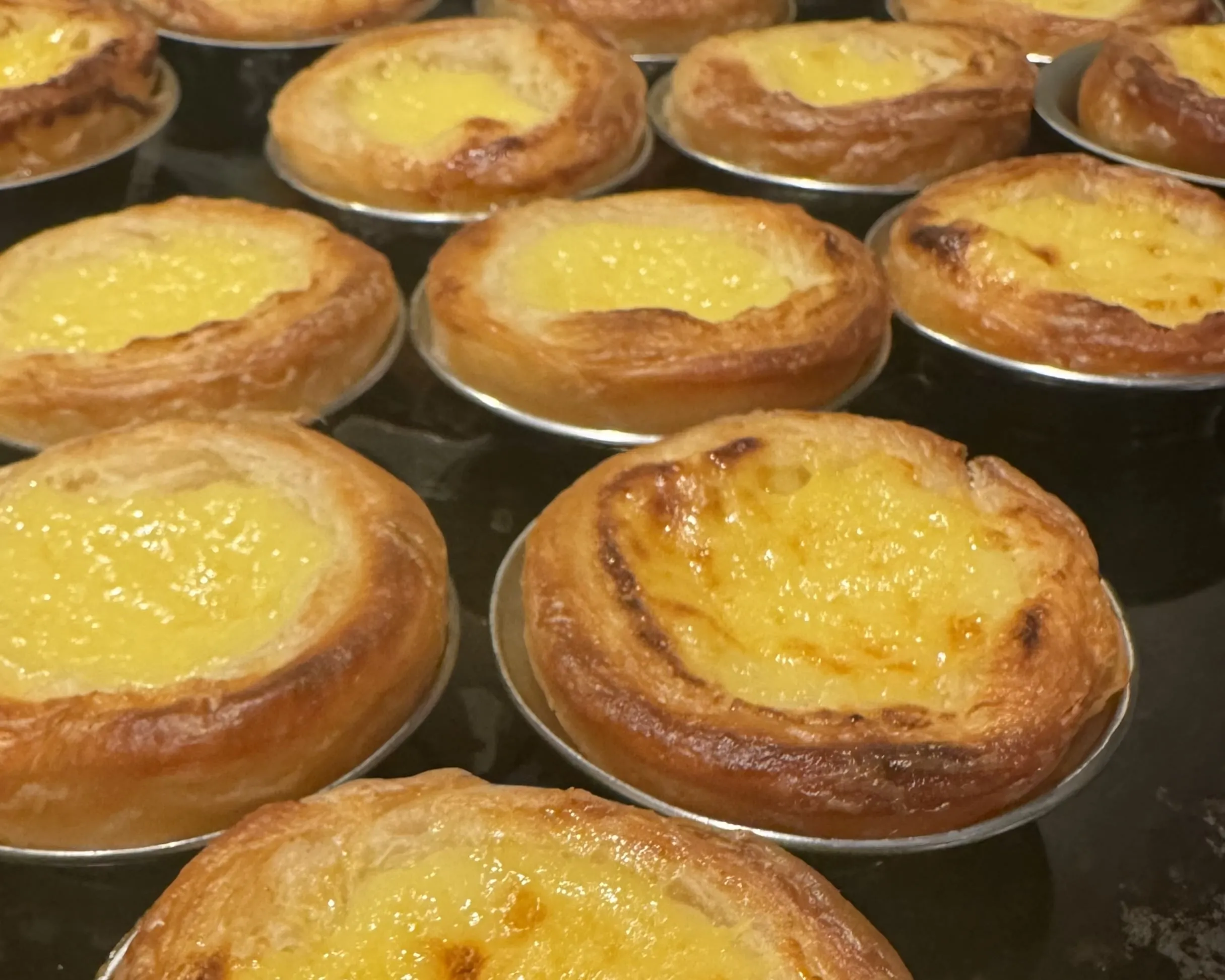
Try not to eat all of them in one sitting.
Crust
Place 250 g Tourage butter (cold) between two sheets of parchment paper. Then, using a rolling pin, roll it out into a thin block. Store the butter block in the freezer for at least 1 hour.
Tourage butter has 82% fat content and is specially formulated for croissants and puff pastry.
Mix 375 g flour and 4 g fine sea salt, add 200 ml water (cold) until the dough is smooth and uniform.
Leave on a floured countertop, cover with plastic wrap and allow it to rest for 10 minutes.
Next roll out the dough until it’s twice the size of the butter block. Place the butter in the center of the dough and fold the edges around it so the butter is completely covered. Using a rolling pin, smooth out the dough with the butter inside, rolling it out without tearing. Fold it once and leave it to rest for 10 minutes.
You may place it in the fridge while you wait. It helps to keep the butter cold.
Roll out the dough and fold it once again. Leave it to rest for another 10 minutes.
For those of you keeping count, we now have five layers of dough and four layers of butter.
Spread out the dough to a thickness of 1 cm. Sprinkle or brush with water and roll it tightly. Place the dough roll on a tray, cover with plastic wrap and keep in the refrigerator for at least 1 hour before use.
When lining the molds, remove the roll from the refrigerator and let it come slightly to room temperature. Stretch the roll a little with your hands until its diameter is slightly smaller than the base of the molds you will use for the pastéis, then cut it into slices about 2 cm wide, depending on the size of the molds.
Place one slice of dough into each mold, with the cut side facing up.
With your thumbs moistened with water, make a depression in the center of the dough taking care not to tear through to the bottom, then pull the edges of the dough upward while rotating the mold. Keep stretching and rotating and until the mold is fully lined and there is a rim of dough all around the upper edge of the mold.
Cover the molds with plastic wrap, and let them sit in the refrigerator for at least 2 hours.
Filling
Pour 400 ml milk into a saucepan and bring to a boil.
In another saucepan, add 500 g sugar, 250 ml water, 1 lemon peel and 1 cinnamon stick, and boil for 3 minutes until it reaches thread stage (106°C). Remove from the heat and measure out exactly 500 ml.
In a bowl, mix 100 g T55 plain flour with 100 ml milk (cold), whisking well until dissolved and forming a paste. Make sure it’s not too thick, or it will not work.
Add a little boiling milk to make the paste more fluid, then add the remaining milk, stirring constantly to combine well and prevent the flour from clumping.
It should turn into a dense cream. If it doesn’t, return it to the stove and cook on low until it thickens.
Gradually add the 500 ml of sugar syrup, stirring constantly until fully incorporated.
Allow it to cool, stirring occasionally with a whisk.
Once cooled, add the 8 egg yolks, mix well, and strain the custard through a fine mesh sieve.
Baking
Preheat the oven for 1 hour to 300°C.
In industrial convection ovens, the ideal temperature is around 270–280°C.
Place the pastry molds lined with puff pastry on a baking tray, spaced apart, and fill carefully without spilling, using a measuring cup or funnel, leaving only a small rim without custard.
Place the tray directly on the oven floor or on the lowest rack, as quickly as possible to avoid heat loss. When the custard starts to caramelize, rotate the tray and move it to the middle rack. Baking should take 10-12 minutes.
If the custard begins to brown excessively while the pastry is still undercooked, open the oven door slightly to allow heat to escape from the top while the bottom continues to bake.
Remove the tray from the oven and immediately sprinkle with cold water using a spray bottle. Let cool slightly and unmold.
Serve the custard tarts warm or cold, plain or dusted with ground cinnamon.